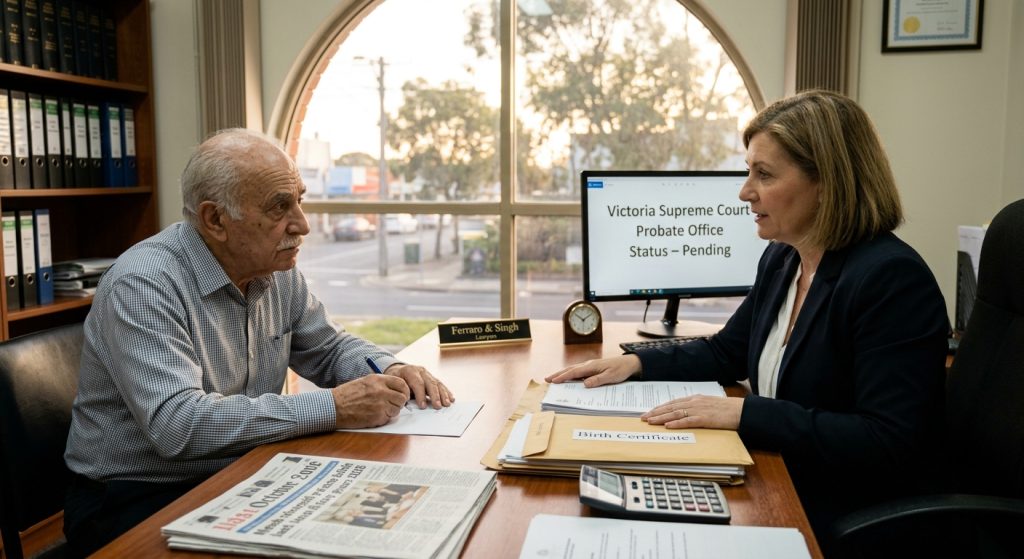

Estate Debts and Liabilities Must Be Addressed
Another reason Executors and Administrators should avoid rushing to distribute an estate is that all outstanding debts and liabilities need to be dealt with.
These may include funeral expenses, mortgages, loans, taxation liabilities, legal and accounting fees, council rates and other property-related expenses.
There may also be expenses that have not yet been finalised.
For example, an Executor may have sold the deceased’s property and received the sale proceeds. While it might be tempting to distribute those funds immediately, there may still be capital gains tax or other taxation obligations to consider.
If the Executor distributes the money without retaining sufficient funds to meet those obligations, they may be personally responsible for the shortfall.
This is why I often work alongside accountants when administering estates to ensure that taxation obligations are properly considered before distributions are made.
Estate Accounts and Beneficiary Acknowledgements
Before an estate is finally distributed, I generally recommend that the Executor or Administrator prepare a statement of estate accounts.
This sets out the assets collected, income received, debts and expenses paid, and the amount remaining for distribution to each beneficiary.
The purpose is simple. Beneficiaries should be able to understand what has come into the estate, what has been paid out and how their inheritance has been calculated.
Depending on the circumstances, beneficiaries may also be asked to acknowledge the accounts and sign an appropriate receipt or release before receiving their distribution.
While these documents do not automatically protect an Executor from every possible claim, they provide an important record and can assist in avoiding disputes later on.
Can an Executor Make an Early Distribution?
Yes, and this is something I am regularly asked about.
There are circumstances where an Executor or Administrator may be able to make an interim distribution before the estate has been fully administered.
For example, an estate may hold substantial cash reserves, with sufficient funds available to cover outstanding expenses and liabilities.
However, just because the money is available does not necessarily mean it should be distributed.
Before making an early distribution, an Executor should consider the possibility of family provision claims, outstanding taxation obligations and whether sufficient funds will remain available to meet future liabilities.
It may also be recommended that beneficiaries sign an acknowledgement and indemnity before receiving an early distribution.
However, an indemnity is not a guarantee. If a beneficiary has spent the money and cannot repay it, the Executor may still find themselves in a difficult position.
For these reasons, early distributions should only be considered after obtaining appropriate legal advice.
When Can an Estate Be Safely Distributed?
Generally, an estate will be ready for final distribution once the Executor or Administrator has collected the assets, paid or made adequate provision for outstanding liabilities, addressed taxation matters, considered potential claims and prepared the final estate accounts.
They can then arrange for the remaining assets to be distributed in accordance with the Will or, where there is no valid Will, the applicable intestacy laws.
Of course, every estate is different, and there is no single timeframe that applies to every estate.
Why Taking the Time Matters
Administering an estate is not simply a matter of collecting money and distributing it to the beneficiaries.
Whether you are an Executor or Administrator, you have legal obligations, and those obligations do not disappear simply because beneficiaries are asking for their inheritance.
In my experience, taking the time to properly administer an estate can save everyone considerable stress, unnecessary legal costs and potential disputes later on.
The aim should not be to distribute an estate as quickly as possible, but to distribute it properly.
After all, the last thing an Executor wants is to find themselves personally liable for a debt or claim that could have been avoided.
Need Assistance With the Administration of an Estate?
At Ferraro & Singh Lawyers, we assist Executors, Administrators and beneficiaries with Probate applications, Letters of Administration, estate administration, distributions and disputes involving deceased estates.
Whether you have been appointed as an Executor, are seeking Letters of Administration or are a beneficiary seeking guidance about an inheritance, our team can provide practical legal advice tailored to your circumstances.
Contact Ferraro & Singh Lawyers to discuss your matter and obtain assistance with the estate administration process.